AWARD-WINNING NOVEL, 2024
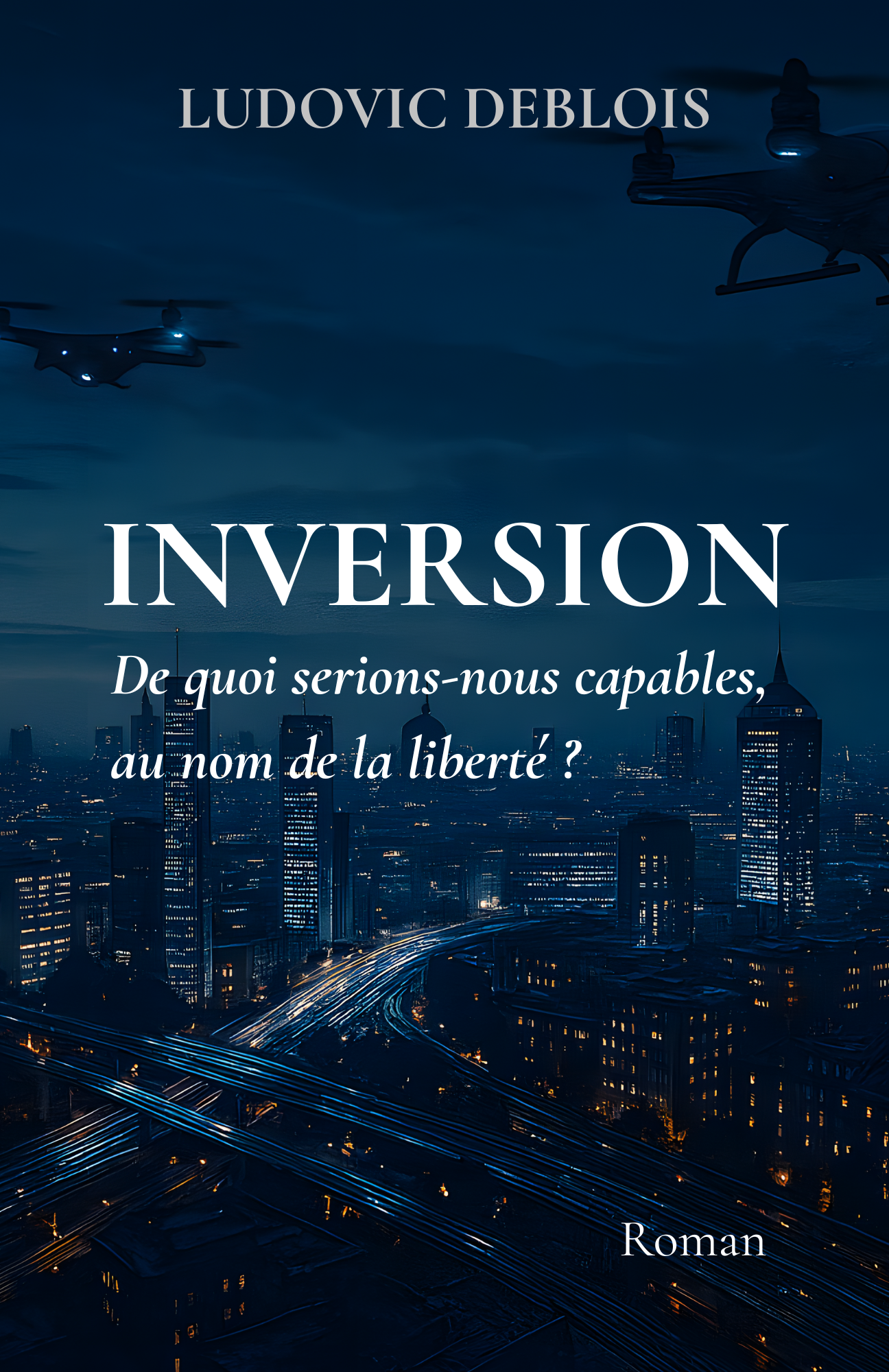
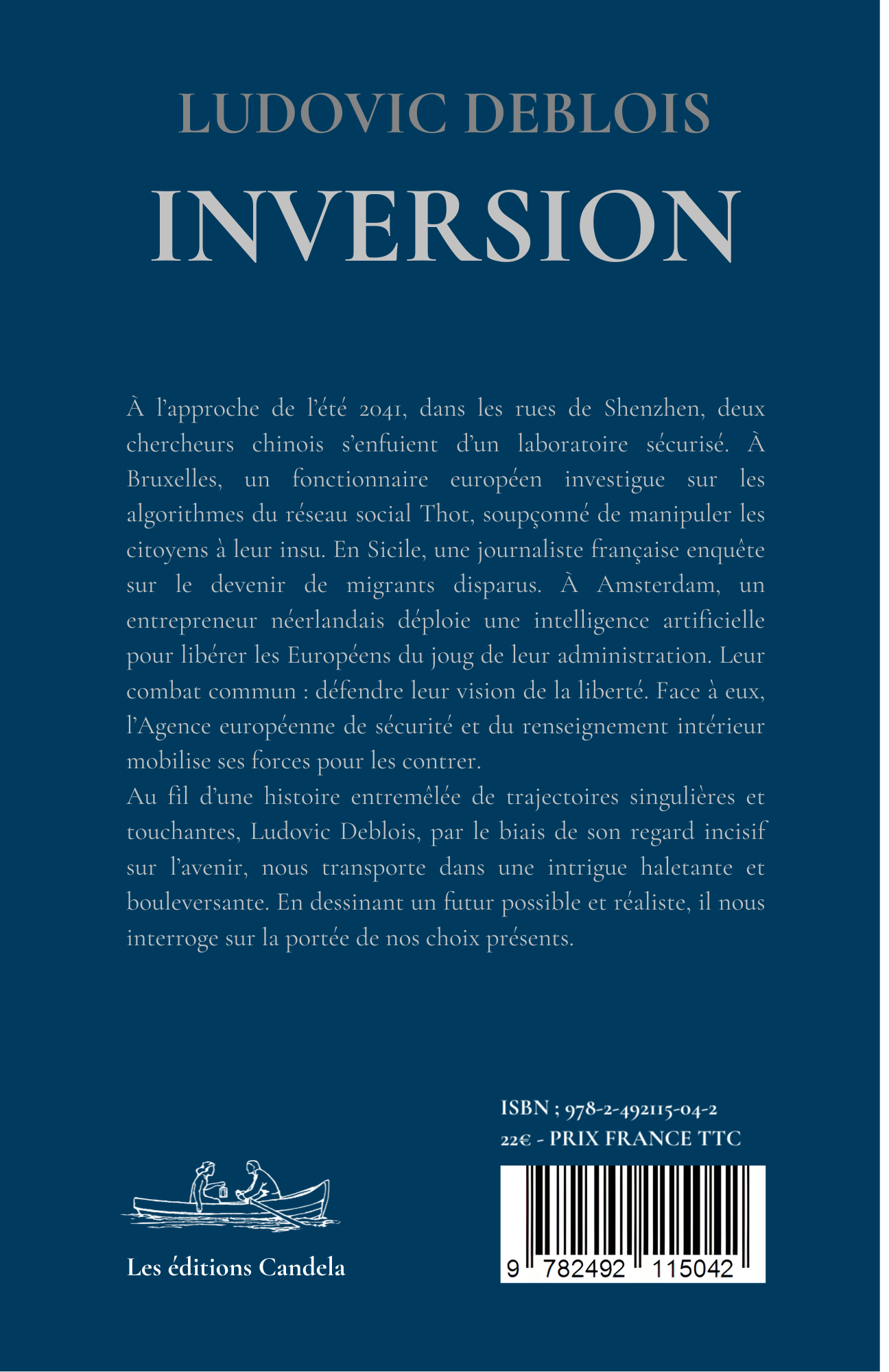
As the summer of 2041 approaches, in the streets of Shenzhen, two Chinese researchers flee a secure laboratory. In Brussels, a European civil servant is investigating the algorithms of the Thot social network, suspected of manipulating citizens without their knowledge. In Sicily, a French journalist is investigating the fate of missing migrants. In Amsterdam, a Dutch entrepreneur is deploying an artificial intelligence to free Europeans from the yoke of their administration. Their common fight: to defend their vision of freedom. Against them, the European Agency for Security and Internal Intelligence mobilises its forces to stop them.
Through a story interwoven with singular and moving journeys, Ludovic Deblois, with his incisive eye on the future, carries us into a gripping and harrowing plot. By sketching out a possible and realistic future, he questions us on the weight of our present choices.
This novel received a Lions Club literary award in 2024.

« Just a generation removed from our own time, humanity has submitted to the dictatorship of the digital. Without realising the underlying manipulation, everyone believes they are choosing their own life, when in fact the dice are loaded, whatever the domain concerned: choice of a partner, career path, place of residence. While a young journalist is determined to expose the migrant trafficking she has just uncovered in Italy, a group of hackers develops an app capable of countering the permanent control of individual lives.
The political and economic stakes are enormous, and the reins are held by the European Agency for Security and Intelligence. The CIA has a modest hand in it too, since the Sino-European bloc dominates the world. A world that is too hot, where once-prized regions are now deserted…
One would be tempted to file this novel under dystopia rather than speculative fiction, so plausible and terrifying does this permanent digital control, along with the ravages of climate change, seem. One nonetheless holds on to the hope that a handful of valiant earthlings, like Sonia and even Lucas, will go to war against the established order.
The whole is built like a thriller. Once the characters are introduced, you get into the plot fairly quickly, and although the roles seem clearly assigned, from the vile Russo to the idealistic Sonia, vigilance is required right to the end.
A well-crafted science-fiction novel, hard to put down, and plausible enough to be moved by the prospects of a near future. »
« Here we are, projected into 2041, into an era that could resemble our own. Ludovic Deblois invites us to discover a Europe where severe heatwaves have altered the distribution of populations, creating ever more complicated migrations. This society of the future has faced numerous challenges thanks to Thot, an increasingly powerful algorithm born of advances in artificial intelligence. But at what price? The question of freedom, of free will, is at the heart of this dystopia with the trappings of a police thriller.
The plot, puzzle-like in shape, is skilfully constructed around characters who, each in their own way, are confronted with the tightly framed management of individuals.
The journalist Sonia is investigating very closely the government's handling of migration, at the risk of leaking highly confidential information.
Lucas, an employee within the European organisation, begins to question the algorithm's influence on his own career, and even on the lives of his loved ones. A sudden death pushes him to investigate…
The wealthy industrialist Arnold has decided to launch the INVERSION programme in order to preserve, at any cost, each individual's personal freedom and to fight the encroachment of the Thot programme on the lives of the European citizens who wish it.
They are all closely monitored by the European Agency for Security and Intelligence, firmly determined to silence opponents of the stable, secure system preserved by the Thot system.
I enjoyed immersing myself in this fictional world, as the author shows the limits and excesses of a society excessively controlled by an omnipresent digital sphere. Certainly one must fight for one's individual freedom, but shouldn't we also reflect on the interests served by those who oppose the system? And can one really fight on equal terms against an entire system? That is the question posed, each in their own way, by all these heroes who cross paths and form alliances throughout the novel. »

« Paths that cross, characters who doubt or who are too sure of themselves, a multiple plot where everything is nonetheless connected to what forms the very essence of every human being: life choices. Are they influenced, are we manipulated consciously or not, how far does our free will go, and do we always have the ability to choose what we truly want? Aren't we obliged to take into account our environment, the people around us, the context? And if we have never known anything else, do we have the power to change the course of a destiny "imposed" on us?
In this novel, an application has been set up and it governs everything. We are in 2041, and the digital has invaded lives. It has become part of daily life, and most people don't ask questions and let themselves be carried along… without deciding, simply because "someone" knows what's best for them.
Here and there are a few rebels, people trying to reverse the trend, to no longer be tracked, to be able to travel without being traced. The Inversion programme is in place to defend freedom, freedoms. But what can a few people do against bulldozers?
Espionage, rebellion, false friends — nothing is easy between the protagonists, and each (of the good ones) must be careful to get through it, but who can be trusted?
With determined writing and a brisk style, Ludovic Deblois draws us into a futuristic vision of our society. We could well find ourselves living what he describes if we forget to stay vigilant against the excesses of the digital world. The argument is thoughtful and well presented.
I regretted that there wasn't, in the opening pages, a sheet introducing the characters; at the start, I was afraid of getting lost. »
« Ludovic Deblois has previously shown an interest in exploring the dangers of environmental hazards and climate change, and those concerns are present in his latest novel, Inversion. There are however other ways that society can be destroyed and Deblois takes account of some of the most dangerous and immediate threats facing us in this futuristic thriller. It successfully extrapolates on situations that we can recognise around us today and, like the best SF, he considers the worst case scenario where we could conceivably end up if we aren't careful. It takes some leaps and could be accused of heading down conspiracy theory territory, but there is nothing here in Inversion that is beyond possible. And, as the author notes, he is writing this in the hope that if we are more aware of the dangers now, we can take steps to ensure that it doesn't actually happen.
In the year 2041, Thot, an information and social networking system has come to dominate in Europe, a single source of information used by 85% of the population. It's seen as providing secure, reliable and informative data for its citizens. There are concerns in some quarters however that the application is being used to exploit, direct and control European citizens, including pushing them towards career choices and even favourable matches for marriage, removing individual liberties in the interests of securing the needs of the state and keeping the rich and powerful in control. The USA and the CIA particular are concerned as there appears to be Asian and Russian influence, and a Eurasian empire would be the USA's worst nightmare.
There are a few other individuals who come to suspect that the intentions of the European leaders are not entirely benign and purely for the benefit of their citizens. Lucas, an IT technician who has been involved in the development of the Thot system, has been tipped off by an American friend of his father's with connections to the CIA. He is reluctant to believe that there is such a programme in place, but decides to make a few calls to his superiors and do a little investigation himself. His former partner Sonia meanwhile, a journalist, has identified something suspicious going on in Mineo in Sicily, with refugees being held captive apparently with the assistance of Chinese officials. Both soon find themselves in a lot of trouble even before they can they can attempt to make their findings known.
There is however another agency at work, a businessman who is developing his own network called Inversion, a growing alternative network where people can carry out financial transactions and movements in privacy. Tian and Jiao, Chinese twins in Shenzhen, have been smuggled out of China and given new identities by a Dutch agent, Magdalena, so that they can work on expanding the Inversion programme. Inversion is like a big VPN with PayPal using cryptocurrency, an effort to regain anonymity and freedom for our digital footprint, an alternative to free the world population from the invasive and controlling shackles of the European system. But how can anyone be sure of the security and privacy of their information on Inversion, or what the real intentions are behind the development of the new system.
The Thot/Inversion conflict is the main concern of Inversion, although elsewhere and in passing Ludovic Deblois paints a terrifying picture of a near-future where the USA also has its own problems with New York devastated by hurricane, Africa and the south of Europe suffering in the grip of an intense heatwave caused by climate change, where huge numbers of refugees have travelled towards Europe and where Europe is at war with Turkey. When you add references to pandemic scaremongering, an authoritarian European superstate, AI technology, robot combatants and guard dogs, Russian troll factories, Chinese expansion and big brother restrictions on press freedoms, there is a danger that the author is indulging in or giving credence to all manner of conspiracy theories.
On the other hand Inversion does make it feel like all of these things can be interconnected, a perfect storm that leads to a Matrix-like manipulation and mind control of an entire population. What it really hits on, as any good speculative SF should do, is look at where we are now and open our eyes to how much of our lives, transactions, behaviours are available online to large systems. Again, we think this is something we willingly share in full awareness of the convenience and benefits it offers in exchange, but we don't really know how our personal data is harvested and used, and how it could be exploited in the future. This is the truly scary element of Inversion, warning us that the road to totalitarianism doesn't require the overthrow of any current system, that it doesn't even need to be carried out in secret as a conspiracy; we can already see that this is a path we are on, with many European and world nations already on the side of authoritarianism, race hatred, anti-immigration and where "freedom of speech" means the freedom to willingly give away your freedoms.
Initially I wasn't so keen on the sexual exploits of Sonia or the details of her history with Lucas (likewise Lucas's history and differences with his father), which scarcely feel relevant and seem to set the book half-heartedly into Michel Houellebecq territory. Their social, political and generational differences however do present different approaches to dealing with the information they are presented with and how they feel about the authorities. Inversion is an ambitious work of speculative fiction with one foot very firmly in present day reality, exploring in detail many of the serious questions we have to face up to today. »