Nouveau Roman !
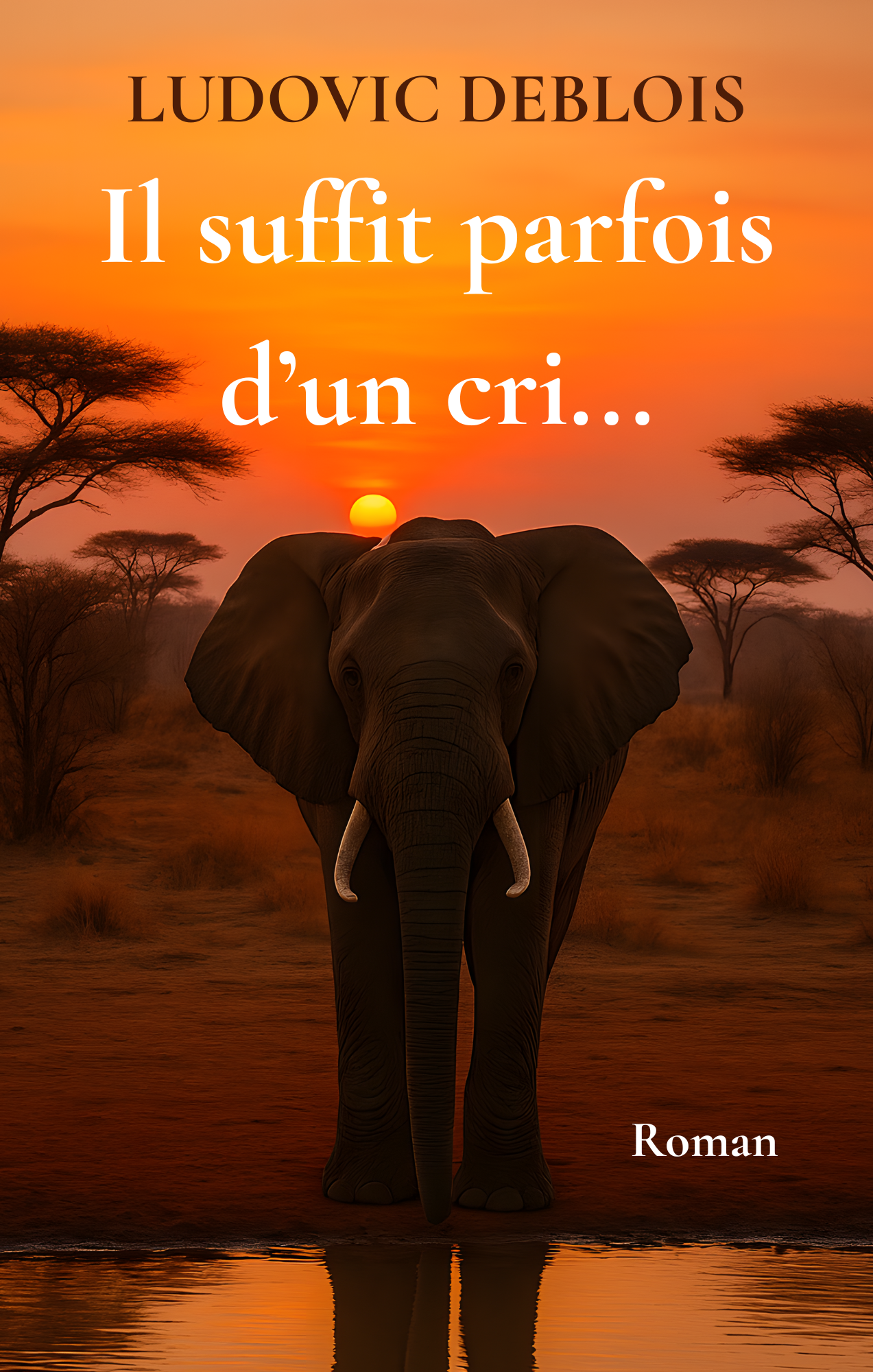
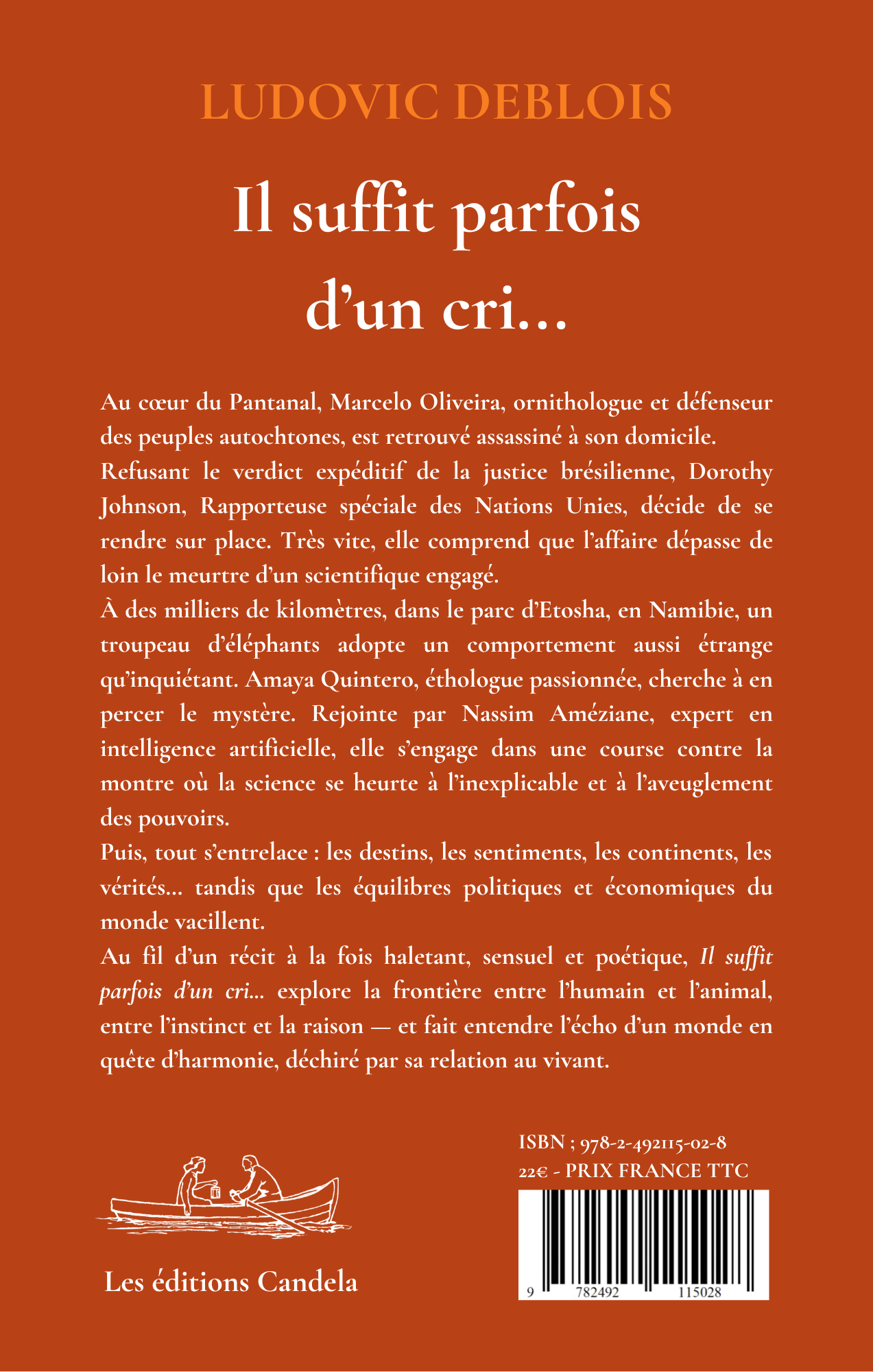
In the heart of the Pantanal, Marcelo Oliveira, an ornithologist and defender of indigenous peoples, is found murdered at his home.
Refusing the summary verdict of Brazilian justice, Dorothy Johnson, Special Rapporteur for the United Nations, decides to travel there. She quickly understands that the case goes far beyond the murder of a committed scientist.
Thousands of kilometres away, in Etosha Park, Namibia, a herd of elephants is displaying behaviour as strange as it is worrying. Amaya Quintero, a passionate ethologist, seeks to unravel the mystery. Joined by Nassim Améziane, an artificial-intelligence expert, she embarks on a race against time in which science collides with the inexplicable and the blindness of those in power.
Then everything becomes intertwined: destinies, feelings, continents, truths… while the world’s political and economic balances waver.
In a narrative that is at once gripping, sensual and poetic, Il suffit parfois d’un cri… explores the border between the human and the animal, between instinct and reason — and gives voice to the echo of a world in search of harmony, torn apart by its relationship with the living world.
A book that makes you question yourself!
The theme of animal welfare stirs something and pushes you to reflect. Reading it inevitably leads you to question your own view of the subject: am I sensitive to it? What place do animals hold in this world, and what place should we grant them?
This reflection, among others, is skilfully carried by characters whose depth triggers a whole range of emotions, from irritation to concern, from discouragement to admiration. In our society, where "I think, therefore I am" is becoming ever more pronounced, I found myself remembering, by the end of my reading, that everyone apprehends the world through their own gaze, chooses their own battles... One is left wondering whether it is still possible to build commitments for the common good...🤞
A book that makes you think and feel! A wonderful read!

I love this "choral" novel because it weaves the portrait of a story that transcends and enriches each of the characters who make it up. I love this book, which carries you off into another world and creates a real jet lag with my own life. It is one of the most striking books I have read. This book carries the cry of the living that sleeps within us and that we forget behind our computers and our endless "to-do" lists. I received a little extra soul while reading it, and I learned many things about animals that I was completely unaware of. This book is overwhelming in how much it embodies life: in its tenderness and intelligence, in its mysteries and its brutality. Thank you and well done.

In a narrative that is at once gripping, sensual and poetic, Il suffit parfois d'un cri... explores the border between the human and the animal, between instinct and reason, and gives voice to the echo of a world in search of harmony, torn apart by its relationship with the living world. After Les Licornes aussi renaissent de leurs cendres..., published in 2020, and Inversion, a dystopian speculative-fiction novel published in 2022 and awarded a Lions Club prize in 2024, I had the pleasure of reading this very successful third novel, which is my favourite. A plot that skilfully alternates between thriller, speculative fiction and romance, over some forty chapters. I recommend this highly enjoyable novel to all nature lovers, who will not be disappointed by this moving and poetic story.
We talk a lot about "weak signals."
In strategy.
In geopolitics.
In economic intelligence.
These early-warning signals that announce a shift.
But first you have to see them.
And, above all, want to read them.
In Il suffit parfois d'un cri… by Ludovic Deblois,
everything starts from signals we would rather ignore.
The cry of a parrot in the Pantanal.
Unusual behaviour among elephants in Namibia.
The possibility, for a meteorological institute, of basing its forecasts on the behaviour of dolphins.
Nothing unpredictable.
Nothing mystical.
Signals.
Readable.
Interpretable.
But politically uncomfortable.
This is not merely an ecological thriller.
It is a staging of our collective blindness.
And it is no coincidence that this book is signed by Ludovic Deblois.
An engineer by training.
A former entrepreneur in solar energy.
Selected among the World Economic Forum's "Technology Pioneers."
He knows from the inside the links between innovation, economic power and political decision-making.
You can feel in his writing this dual culture:
technical rigour… and awareness of systemic blind spots.
What struck me was the scientific credibility of the argument — and above all the place given to artificial intelligence.
In the novel, AI is not a futuristic gadget.
It becomes a tool for analysing complex biological signals.
Decoding sounds.
Identifying correlations invisible to the human eye.
And this echoes very real research.
Modern ethology shows that many species structure elaborate forms of communication.
Bioacoustics is progressing rapidly.
Scientific teams are already using AI models to analyse masses of sound and behavioural data that are impossible to process at human scale.
In other words:
One of the most powerful technologies we have developed could help us… to listen to the living world.
Stop.
Because understanding is not enough.
The book stages a gap we know all too well:
between the scientific signal and the political decision.
The IPCC documents the intensification of climate change.
IPBES warns of the accelerating erosion of biodiversity.
The data exists.
The question becomes strategic.
If the living world emits early-warning signals of imbalance,
and if AI can help decode them,
then ignoring these signals is no longer merely an ecological error.
It is a failure of governance.
For businesses and territories, the stakes go far beyond "environmental sensitivity."
Our economic models depend on ecosystem services:
soil, water, climate stability, pollination.
Not understanding these dependencies
means steering without a dashboard.
This novel reminds us of something essential:
The living world is not only something to protect.
It is an ally in adaptation.
Provided we listen to it.
Are we ready to do so?