
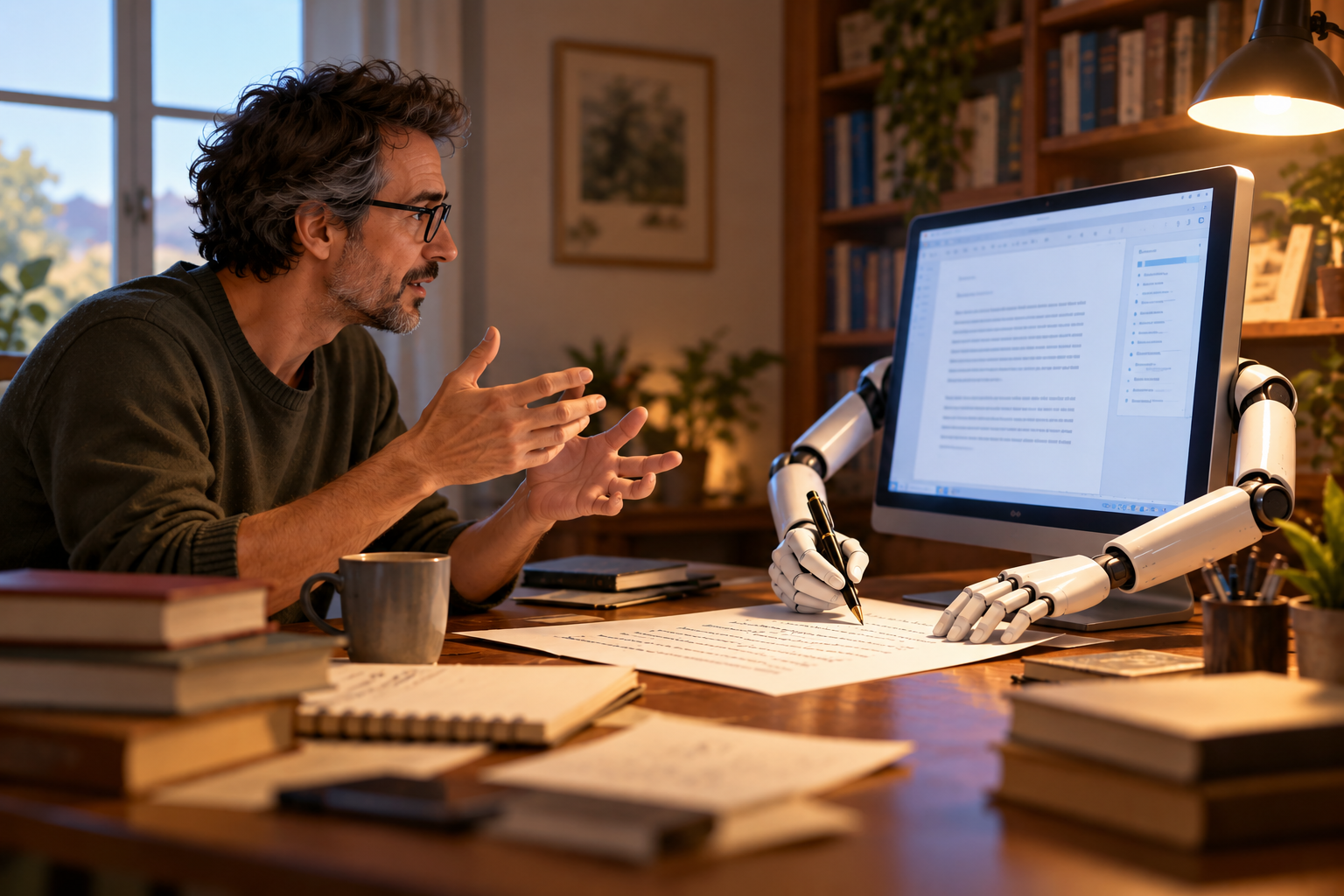
Writing: the preserve of intellectuals?
Given the way our societies are organised, it is particularly difficult for someone without a literary or intellectual background to carve out a place among columnists and writers. Writing must be mastered, because ideas demand discernment and clear language, while descriptions require precision and authenticity in order to stir emotion. Finally, the literary world can seem, in many cases, an inaccessible world, reserved for a privileged few.
In this sense, artificial intelligence, which is mastering grammatical structures, conjugation and spelling ever better, can provide considerable support to a novice author who might never have taken the plunge into writing without it. Even so, must this novice author give up their autonomy in favour of a machine that writes for them, that becomes an emotionless ghostwriter?
AI style annihilates individuality
For many texts delegated to AI, it remains fairly easy to recognise a book in which AI has had a hand. Even when the content is interesting and relevant, the eye grows weary as the reading goes on if the author has effaced themselves. Why? Simply because AI makes excessive use of efficient constructions, on the pretext of improving coherence and clarity. A brain accustomed to reading original content notices this and quickly tires of the redundancy.
In particular, texts produced by AI display a profusion of figures of speech strung one after another. One common example is the recurring use of antithesis in posts or op-eds: “The question is not whether… but understanding why…” Another illustration is the abundance of short sentences following one another to create a break and try to hold the reader’s attention.
To this profusion of regularities is added the smoothing effect produced by AI as it tries to create a perfect text. Based on 880,000 texts, a study published in Nature Human Behaviour[1] shows that the adoption of LLMs as writing assistants is accompanied by a decline in linguistic diversity and a homogenisation of writing styles. It also notes that this shift “harms the societal and psychological knowledge that language conveys.”
Moreover, when it tackles writing, artificial intelligence does so without recourse to emotion, and this can be seen as one of the pitfalls of fully delegating writing to AI. When a writer uses a turn of phrase, a break in the text or a figure of speech, they do not necessarily think about its effectiveness: they let the sentences come according to their mood, their impressions, their experience and their sensibility. This is how a text takes on its full strength, because through the narrative one connects directly with the person writing it, or with the character whose feelings the author strives to reproduce. One finds oneself carried off by the author into an unknown horizon which, little by little, becomes familiar or foreign, and therefore captivating.
By delegating our writing to artificial intelligence, we therefore risk producing similar content, which erases individuality, impoverishes our language and could affect the development of our emotional intelligence, which needs a richness of vocabulary.
So should we, as some proclaim, refuse to use AI for writing?
Once again, artificial intelligence can be a formidable agent for dismantling elitism. However, in my view, it must not replace the author. It can play the role of proofreader, hunting down spelling and conjugation mistakes, flagging awkward phrasing, just as the Antidote software or a human proofreader would — something not every author or every independent publishing house can necessarily afford.
It can also train a novice author by helping them work on texts until they find their autonomy before embarking on a book, and this is perhaps the most important point. It is common to come across people who want to write but cannot cross that threshold, either because of a disability or simply because of a difficulty in writing and trusting themselves. AI, just like a piano teacher, can help, at lower cost, to practise and improve. But would it occur to us to delegate to a teacher the carrying-out of our tasks after they have taught us how to do them ourselves?
The hardest part of writing, as with any form of art, is acquiring this self-confidence. And it is not by delegating that one acquires it, but through work and refinement. This is how the pleasure of writing gradually takes hold of the author and pursues them body and soul. Our full schedules, our laziness or our doubts, whose existence stirs up an unpleasant feeling, must not lead us to delegate this extra touch of soul.
And if you have any doubt, try the test: generate a text entirely with AI and observe what stays with you. Perhaps simply the impression of having managed to express something and to be understood, an impression that evaporates as quickly as the buzz of an aperitif on a terrace, on a sweltering evening. And what is the point of it if nothing personal comes through, since this text could have been written by thousands of other people, and if new ideas dwindle over time?
A study published in Computers in Human Behavior: Artificial Humans[2] analysed 2,200 university admission essays: each essay written by a human contributes more new ideas than each essay generated by GPT-4. A study published in Science Advances[3] even shows that ideas suggested by AI mainly improve the narratives of the least creative authors, but make texts more similar to one another.
Even if the benefit is very significant for the least creative people, thus allowing for a kind of democratisation of writing, should this come at the expense of diversity?
What levers do we have to safeguard the sanctity of writing in the digital world?
The stakes are complex, and for many authors, the mere fact of asking this question is terrible and deeply sad. Writing, like many forms of art, is an extension of consciousness. Cutting off this armed extension of consciousness is like amputating a part of oneself. For many people, myself included, it would mean breaking a reason for being in the world.
But can one reasonably imagine confining the use of AI within the bounds of literature? In other words, could literature be turned into a sanctuary? It already seems too late, since AI has had access, often without the consent or the payment of authors, to a great many books. And its use has already spread into many professions. So how can we prevent AI from writing a novel or an essay, reports and op-eds, if it is already producing them? Wanting to turn back the clock seems illusory…
So what should be done? There could possibly be the option of creating labels, as with food products, indicating whether the content has been corrected, co-written — what one might call hybrid writing when it intervenes as much on style as on ideas or phrasing — or written entirely by artificial intelligence.
This label, if certified by an independent body, could possibly provide an answer, but it would draw the book into an even more commercial logic than today’s, since it would become a standard product stamped with a brand image supposed to reveal its quality. A voluntary, self-declared mention, without commercial certification, could for example remove this objection.
The other option would be to do nothing and hope that human writing will always retain its singularity, because even if artificial intelligence were equipped with billions of sensors, it would not have a connection to reality similar to a human being’s. But isn’t that a somewhat risky bet?
AI’s conquest of writing reveals something about ourselves
The dominance of technology in our lives is colliding head-on with our ways of living, drawing us away from our connection to the living world. Until now, writing has been like the imprint of a wolf’s paws on the ground: a way of recognising or discovering oneself, of connecting. It is an emanation of the living.
If the writer subordinates their craft, submits to the stylistic injunctions of a machine, is that not a renunciation of our greatness of soul? Is it not also a slackening of our propensity for effort and of our capacity to reveal our full inner potential?
If AI remained only a tool, concerned with training us to become a better version of ourselves, the debate would no doubt be closed, except for those who would see in it the threat of everyone gaining access to a knowledge they enjoyed being alone in holding. But are we already becoming, over time, insidiously, literary customers who order a text the same way they would a pair of shoes? Probably not yet.
Even pressed by the need for productivity and performance, humanity can still choose between submission and the pursuit of its emancipation. To do so, it seems to me, it should continue to be able to tell apart a page produced by a human from one written by artificial intelligence. Artists, just as much as scientists and innovators, must retain a place in society, for without art, what would become of freedom and the emergence of truth within each of us? The recent controversy surrounding the author Thélyson Orélien[4], whose novel is accused, on the strength of a detection tool, of having been written by AI — which he disputes — teaches us how much we care about the authenticity of writing, how much literature produces an unbreakable bond between author and reader, because what moves us, at least for now, is human experience and human nature.
It also shows that we may, in time, find it hard to know whether a text is the personal output of an author, which is why the option of making it a voluntary, self-declared mention is probably the only way out. Moreover, as long as there remain writers who refuse artificial intelligence, as long as they manage to produce new ideas and an authentic style, the effect of artificial intelligence will probably be confined to that of a ghostwriter, allowing a rich and diverse literature to persist. Just as the farmer must showcase their produce against industrial agriculture, is it not up to the human author to demonstrate their worth against machine-generated content? This answer may well remain provisional, so rapid is the progress of AI: today’s solutions can quickly prove inadequate.
One thing is certain: for many writers, unable to live without their pen, artificial intelligence adds to the many battles they must already fight. To the precariousness and the difficulty of breaking through is now added the need to exist and to be recognised as a human author. Proving one’s humanity — that is a battle for which no writer had probably ever prepared.
[1]Zhivar Sourati et al., “The shrinking landscape of linguistic diversity in the age of large language models”, Nature Human Behaviour, 2026, https://www.nature.com/articles/s41562-026-02550-0.
[2]Kibum Moon, Adam E. Green, Kostadin Kushlev, “Homogenizing effect of large language models (LLMs) on creative diversity: An empirical comparison of human and ChatGPT writing”, Computers in Human Behavior: Artificial Humans, 2025, https://www.sciencedirect.com/science/article/pii/S294988212500091X
[3]Anil R. Doshi, Oliver P. Hauser, “Generative AI enhances individual creativity but reduces the collective diversity of novel content”, Science Advances, 10(28), July 2024, https://www.science.org/doi/10.1126/sciadv.adn5290
[4]“Novelist Thélyson Orélien, accused of having used AI, denounces a ‘wish’ to ‘silence’ him”, franceinfo, 24 September 2026, https://www.franceinfo.fr/culture/livres/le-romancier-thelyson-orelien-accuse-d-avoir-utilise-l-ia-denonce-une-volonte-de-le-faire-taire_8208251.html